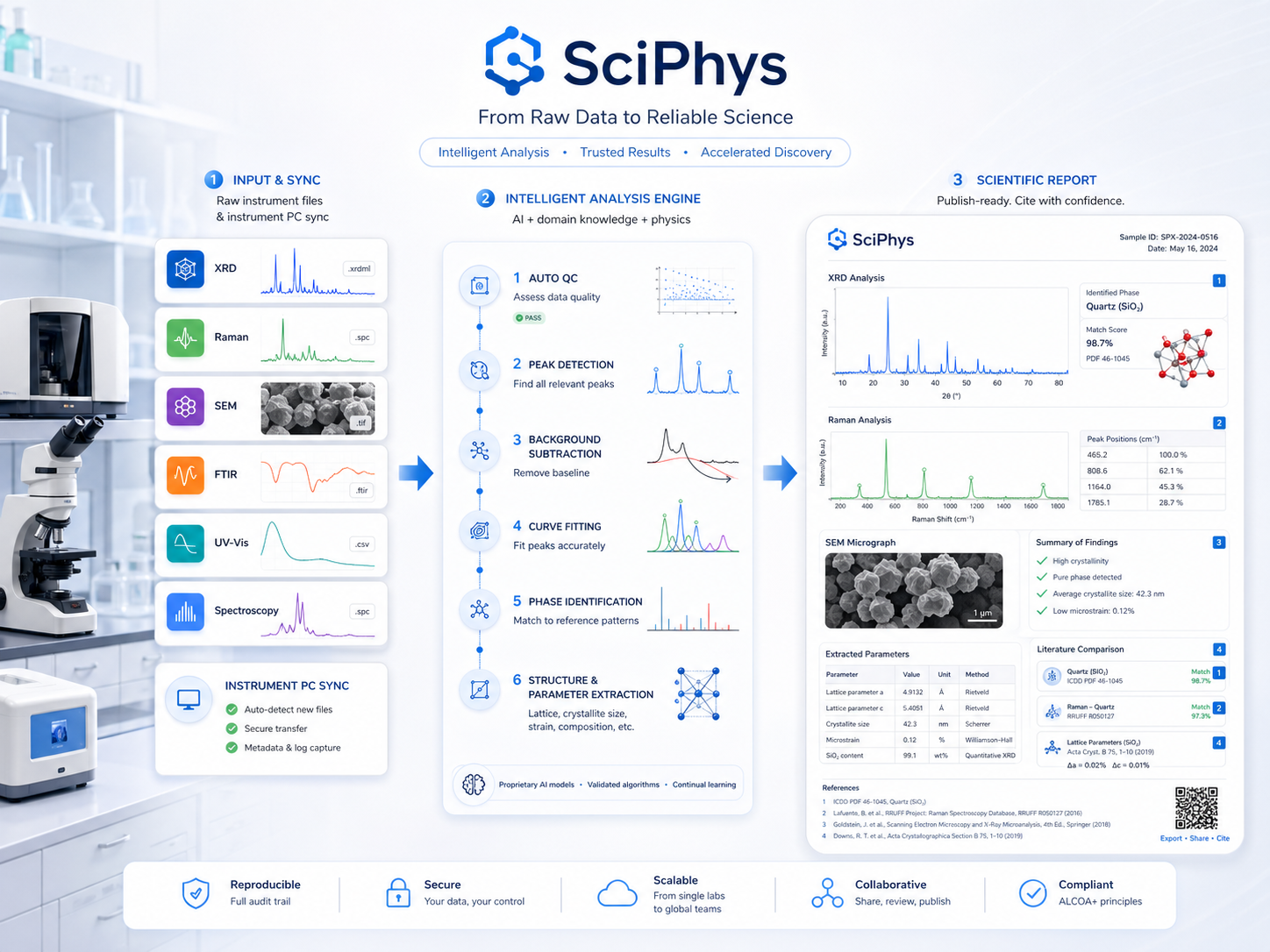
XRD analysis

Evidence-based XRD analysis for real experimental data.

SciPhys helps researchers move from a raw diffraction file to phase evidence, refinement diagnostics, structure context and exportable figures.

Peaks

Detect, label and review matched and unmatched peaks.

Phases

Compare candidate phases with visible reference sticks.

Reports

Export figures, fit data, phase tables and interpretation notes.

What it does

Built around scientific evidence.

Phase identification with a visible evidence chain

For early researchers, the hardest part of XRD is knowing why a phase was suggested. SciPhys exposes matched peaks, missing peaks, unexplained peaks and confidence signals instead of hiding the reasoning.

  • Reference sticks sit under the measured pattern for direct visual inspection.
  • Matched and unmatched peak counts make weak assignments easier to question.
  • Candidate phases can be enabled or disabled during review.

Refinement workspace for publishable outputs

SciPhys supports automated refinement-style fitting and guided user adjustments so the researcher can inspect residuals, phase contributions and refined structure parameters.

  • View Rwp, Rp, GOF and residual traces.
  • Export publication-style plots and tabular results.
  • Track refinement settings so results remain reproducible.

Structure context alongside the pattern

When structure data is available, the XRD view can connect phase evidence to CIF-derived lattice parameters, atomic sites and a 3D structure view.

  • Use CIF and reference data to explain peak positions.
  • Review lattice, symmetry, Wyckoff and occupancy fields.
  • Connect diffraction evidence to material-level interpretation.

Workflow

From raw files to research decisions.

01

Upload

Import raw, xy, csv, xrdml and supported instrument files.

02

Match

Detect peaks and compare them against candidate reference patterns.

03

Refine

Inspect fits, residuals, refined parameters and export-ready figures.

FAQ

Questions researchers ask first.

Can SciPhys identify multiple XRD phases?+

Yes. The XRD workflow is designed to show candidate phases, matched peaks, missing peaks and unexplained peaks so multiphase or impurity assignments can be reviewed.

Does SciPhys replace GSAS or FullProf?+

SciPhys is not positioned as a black-box replacement for expert refinement packages. It focuses on faster evidence-based phase review, guided fitting, reporting and lab workflow integration.

Can I export XRD results?+

Yes. SciPhys is designed to export plot data, figures, phase tables, refinement summaries and report-ready interpretation text.