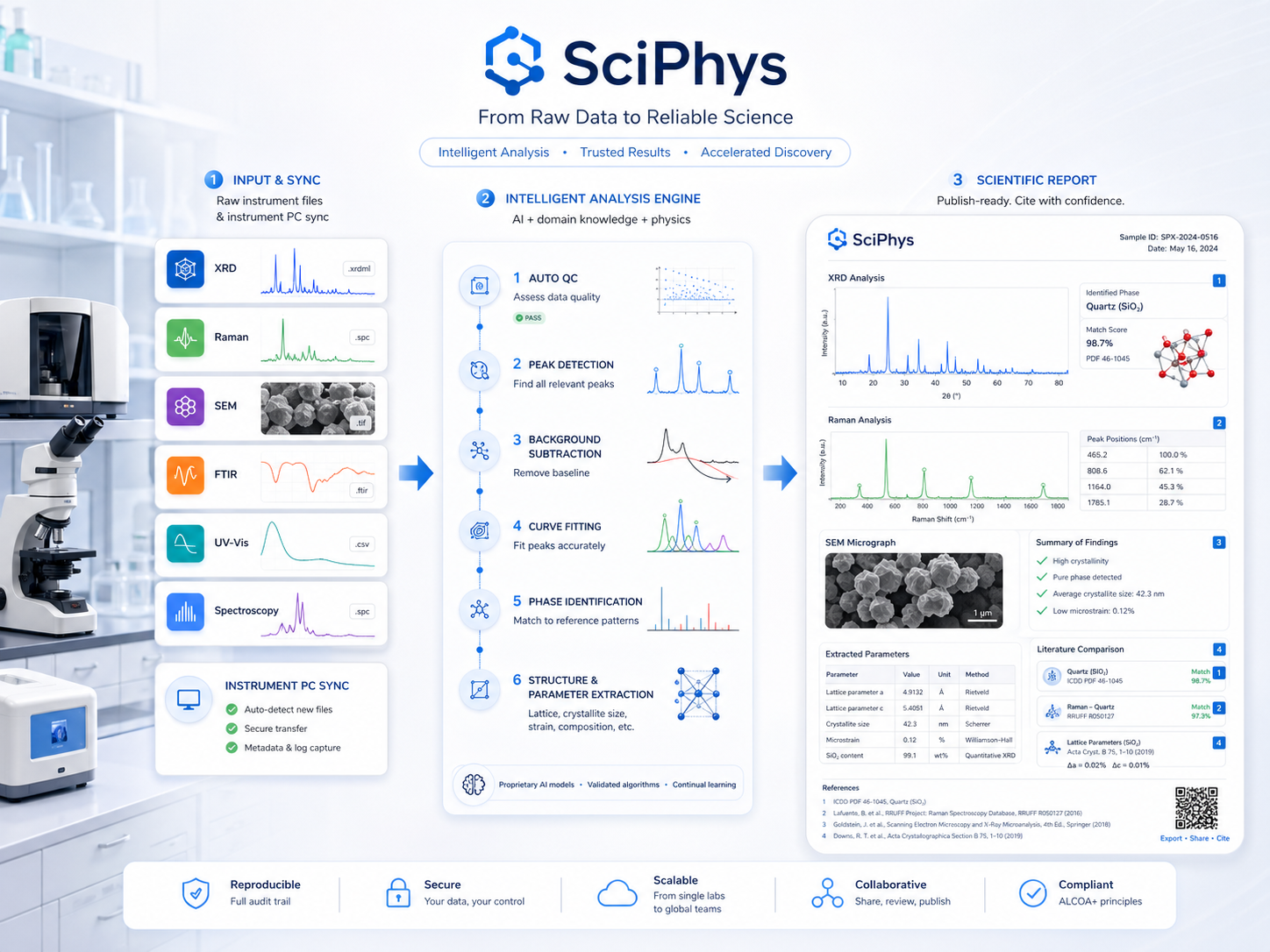
Built for real student XRD data
Experimental scans rarely look like textbook patterns. SciPhys keeps weak peaks, broad peaks, shifted peaks and noisy regions visible so the user can judge whether the phase call is credible.
- Inspect observed peaks alongside candidate reference patterns.
- Separate confident matches from unresolved or suspicious peaks.
- Use composition hints and sample context to narrow candidates.
Multi-phase and impurity review
The most useful phase identification workflow is not only the main phase. It should help new researchers understand what may be secondary, missing, shifted or unexplained.
- Compare primary and impurity phase candidates.
- Track missing strong reference peaks before accepting a result.
- Explain why a single strong peak is not enough evidence.
Connected to the lab record
A phase decision becomes more valuable when it is saved with the file, sample, project, measurement details and future advisor review.
- Save phase evidence in the same workspace as the raw file.
- Export tables and figures for group meetings or papers.
- Search later by material system, student, project or conclusion.